
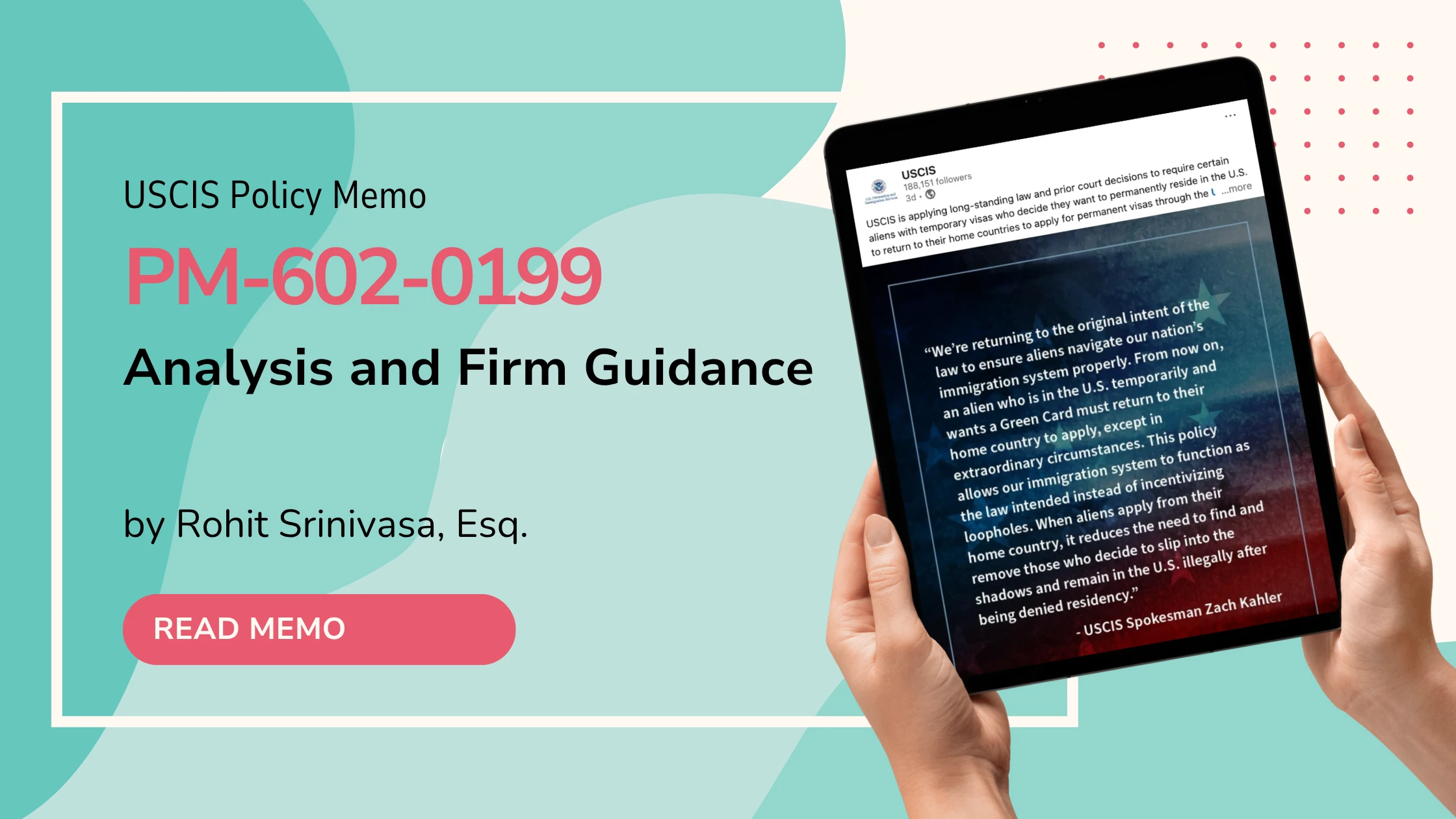
USCIS Policy Memo PM-602-0199 – Analysis and Firm Guidance
Date: May 25, 2026
From: Rohit Srinivasa, Esq. – Inventimm PC
Re: USCIS Policy Memo PM-602-0199 – Analysis and Firm Guidance
What Is Going On
On May 21, 2026, USCIS issued Policy Memorandum PM-602-0199 (“Memo,”) directing officers to treat every Form I-485 filing as a discretionary matter requiring affirmative justification, not merely a technical eligibility review. The memo does not eliminate adjustment of status (“AOS”), change who is eligible to file, or require anyone to leave the U.S. and consular process. What it does is raise the practical bar for approval and introduce real uncertainty, particularly for applicants with any immigration history complications.
The memo reaffirms a legal principle that has existed since 1952 and been affirmed through the Supreme Court as recently as 2022: AOS is a matter of grace, not a right. What is new is the signal to officers to look harder, weigh adverse factors more actively, and treat AOS as genuinely extraordinary rather than routine. The practical result is the same whether one reads this as a legal restatement or as a covert policy tightening: how your I-485 is built and documented now matters far more than it did one month ago.
Inventimm PC’s response is precision, not panic. We are strengthening every I-485 submission we prepare and conducting more rigorous pre-filing case assessments for every client.
What the Memo Says
AOS under INA Section 245(a) allows a foreign national inside the U.S. to obtain a green card without departing for consular processing. The statute says the Secretary “may” adjust status “in his discretion.” The memo draws on decades of case law, including Matter of Blas (BIA, 1974), Patel v. Garland (U.S. Supreme Court, 2022), and numerous circuit court decisions, to reaffirm that this is genuinely discretionary: meeting the eligibility requirements is necessary but not sufficient. The applicant also bears the burden of showing the case merits a favorable exercise of discretion.
The Memo instructs officers to weigh, among other things: violations of immigration law or status conditions; fraud or misrepresentation in any government dealings; conduct nconsistent with the purpose of the nonimmigrant visa or parole; failure to depart as expected; and the fact that the applicant is seeking to avoid the ordinary consular process. It specifically calls out failure to depart as “highly relevant,” particularly when the applicant could have pursued consular processing. It also notes that maintaining lawful dual-intent status (H-1B, L-1, etc.) is a positive factor but is not by itself sufficient to warrant approval.
The Memo closes by announcing that USCIS will issue further category-specific guidance, and that all discretionary denials must include a written analysis identifying positive and negative factors and explaining why the negatives outweigh the positives.
What the Memo Does NOT Do
It does not eliminate AOS, create new statutory bars, require consular processing, or apply to non-discretionary categories. It does not give USCIS unlimited authority to deny clean cases arbitrarily.
What It Really Means
The critical safeguard for clean cases
The USCIS Policy Manual, which this memo cross-references and has not revised, contains an important protection:
“An alien’s threshold eligibility for the benefit sought is generally also a positive factor. Therefore, absent any negative factors, USCIS ordinarily exercises discretion positively. Generally, if there are no negative factors to weigh against that positive factor, denial of the benefit would be an inappropriate use of discretion.”
This means USCIS cannot simply invoke discretion to deny a clean case. The agency must identify specificadverse factors, weigh them against positives in writing, and explain why the negatives prevail. We will hold USCIS to that standard.
Who faces heightened risk
The memo is most threatening to applicants who have any of the following: unlawful presence or overstays (even brief); unauthorized employment; status gaps or reinstatements; parole-based AOS pathways (CHNV, humanitarian parole – high risk); entry without inspection; prior fraud or misrepresentation; criminal history; or situations where the applicant clearly stayed in the U.S. to avoid consular processing.
Who is better positioned
H-1B, L-1, and O-1 holders with continuous lawful status and authorized employment; EB-1, EB-2 NIW, and other employment-based applicants with strong approved petitions; immediate relatives of U.S. citizens with clean histories; applicants with no status violations, no unauthorized work, and no adverse immigration or criminal record.
AOS vs consular processing
Right now, the choice between filing I-485 and departing to consular process is a genuine strategic question, not a matter of convenience. Consular processing carries its own serious risks: consular nonreviewability (no judicial review of a visa refusal), potential triggering of the unlawful presence bars on departure, physical separation from family and employment, and lengthy processing times. For applicants with clean records and strong equities, AOS remains the better path in most cases. For applicants with complications, the calculus shifts. This analysis must be done case by case.
Factors USCIS Will Weigh
| Positive Factors | Negative Factors |
| Meeting threshold eligibility requirements | Overstays or unlawful presence |
| Continuous, unbroken lawful status | Unauthorized employment |
| Authorized employment only | Fraud or misrepresentation (any government agency) |
| Tax compliance (file transcripts, not just returns) | Conduct inconsistent with visa purpose |
| Family ties; hardship to U.S. family if denied | Failure to depart when expected |
| Professional value, EB-1/EB-2 NIW achievements | Prior removal or deportation orders |
| U.S. education, specialized skills | Criminal history (arrests, convictions, patterns) |
| Property, business, or investment ties | Tax noncompliance |
| Community ties and civic involvement | Child support or court order violations |
| No criminal history; good moral character | Support for anti-American/terrorist organizations |
There is no point system. One serious negative (fraud, serious criminal conduct, major status violation) may outweigh many positives. Where serious adverse factors exist, the standard from Matter of Blas applies: the applicant must show “unusual or even outstanding equities” to overcome them. In a clean case with no negatives, that heightened standard does not apply, and denial is ordinarily inappropriate under the Policy Manual.
Our Approach
We are taking this memo seriously and have made the following changes to how we handle every AOS case:
- Affirmative equity documentation in every I-485: Every I-485 submission from our firm now includes a structured legal argument for favorable discretion, built around: a verified immigration timeline showing every status and period of authorized activity; tax transcripts; employment authorization documentation tied chronologically to work history; professional achievements (connecting I-140 petition evidence directly to the discretionary analysis for EB applicants); and family hardship evidence where applicable. The I-485 is no longer a bare form package.
- Pre-filing case assessment: Before any I-485 is filed, we assess potential discretionary risk factors across the full immigration and personal history. If complications exist, we address them proactively in the record rather than hoping the officer does not find them.
- Strategic AOS vs. consular processing counseling: For every client where consular processing is available, we provide documented counseling on the strategic choice. The right answer depends on visa category, immigration history, admissibility issues, travel risks, family circumstances, and the specific risk profile under PM-602-0199. There is no default answer.
- Aggressive response to RFEs and NOIDs: If USCIS issues a Request for Evidence or Notice of Intent to Deny citing discretion, we will respond in detail, invoke the Policy Manual’s protection against arbitrary denial in clean cases, and challenge any vague or unsupported adverse finding. Where USCIS denies improperly, we are prepared to litigate in federal court.
Frequently Asked Questions
Does this memo mean I cannot adjust status anymore?
No. AOS remains available. The memo does not eliminate the pathway, change filing eligibility, or require departure. For clean cases, the outcome should be the same. For cases with complications, the stakes are higher.
I meet all I-485 requirements. Does USCIS have to approve my case?
In most categories, no – not automatically. Eligibility is necessary but not sufficient. However, the Policy Manual says eligibility is itself a positive factor, and that denial in a case with no negative factors would generally be inappropriate. Our job is to document your eligibility and equities thoroughly so USCIS cannot reasonably deny.
I had a status gap / short overstay / F-1 reinstatement. Is my case over?
Not necessarily. These are adverse factors, not automatic disqualifiers. They must be weighed against your full equities record. The right response is honest, thorough documentation: explain the gap accurately, show it has been corrected, and present every positive factor in your record. Cases with complications require more work, not abandonment. Contact us before filing.
My H-1B is current and I am maintaining lawful status. Is that enough?
Maintaining dual-intent status is a significant positive, and the memo explicitly recognizes that filing for AOS is not inconsistent with H-1B or other dual-intent categories. However, the memo is equally explicit that lawful status alone is not sufficient. Document everything: tax compliance, authorized employment history, professional value, family ties.
Should I leave the U.S. and consular process instead?
It depends on your facts. Consular processing is not risk-free: visa refusals are not judicially reviewable, departure can trigger unlawful presence bars in certain cases, and separation from U.S. employment and family is costly. For most clean-record applicants, AOS remains the better option. For applicants with prior violations, the analysis shifts. Do not make this decision without a consultation.
My I-140 petition indicated that I intend to adjust status. Can I switch to consular processing?
Yes. you can switch to consular processing at any time. The tradeoff: switching to consular processing requires submitting a special form, paying extra fees, and typically adds several months to your timeline. If you are uncertain which path to take, consular processing is generally the safer default right now.
Can USCIS just deny my case because AOS is “discretionary”?
No. The Policy Manual requires a reasoned, individualized written analysis: specific positive factors, specific negative factors, explanation of why the negatives prevail. A vague discretionary denial without identified adverse findings is legally vulnerable and can be challenged on appeal or in federal court.
What should I do right now?
Gather your complete immigration record and organize it chronologically. Locate your last three years of tax transcripts. Confirm that every period of U.S. employment was covered by proper authorization. Do not travel outside the U.S. without consulting us first. If you have any complications in your history, schedule a case assessment before filing. Contact our office to discuss your specific situation.
Questions? Contact Us.
Every case is different. If you have a pending I-485, are planning to file, or are unsure how this memo affects you, contact Inventimm PC at rohit@inventimm.com to schedule a consultation.
Disclaimer:
This memorandum is for general informational purposes only and does not constitute legal advice specific to any individual’s facts or circumstances and does not create an attorney-client relationship. Please contact Inventimm PC for advice specific to your case. Rohit Srinivasa is licensed to practice immigration law in the United States. (c) 2026 Inventimm PC.
Not sure if you qualify for O-1A, O-1B, EB-2 NIW or EB-1A?
Fill the form and get FREE ASSESSMENT from our attorney or book 20min. introducing consultation.