
L-1 New Office Visa: The Complete Guide for Startup Founders
Everything you need to know about using the L-1 new office route to move yourself into your own US expansion: eligibility, what counts as a “new office,” the one-year approval period, extension strategy, manager and executive requirements, and how your family is covered.
When evaluating options for launching a U.S. branch, international founders often look at three primary toolkit options: the L-1, the O-1A, and the E-2. If you have determined that an L-1 visa for USA expansion fits your growth strategy, this guide goes deep on the specific route that trips up the most founders in practice: the L1 visa new office petition.
The new office L-1 petition is uniquely powerful because it allows you to do something the standard L-1 does not: move to the U.S. to build the office rather than waiting to transfer after a thriving office already exists.
That flexibility comes with a clear tradeoff. U.S. Citizenship and Immigration Services (USCIS) grants a shorter initial approval period and expects you to prove, twelve months later, that you built a real, sustainable business. Get the setup right, and you have one of the cleanest founder-to-green-card paths available. Get it wrong, and you spend your first year fighting a Request for Evidence (RFE) instead of scaling your business.
Here is how the L1 visa for USA expansion actually works when you are a founder transferring yourself.
What the L-1 New Office Route Actually Is
The L-1 is an intracompany transferee visa designed to let multinational companies transfer qualified employees from a foreign entity to a related U.S. entity. For founders, the useful twist is that you can sit on both sides of that transfer: you are the key employee being moved, and your business entity is doing the moving.
The visa comes in two distinct forms:
- L-1A Visa: Reserved for managers and executives.
- L-1B Visa: Reserved for employees possessing specialized knowledge.
For a founder relocating to launch and run a U.S. business, the L-1A category is almost always the stronger fit.
“New office” is a specific legal USCIS category rather than a marketing phrase. It applies whenever your U.S. entity has been doing business for less than one year at the time of filing. Because there is no long-term track record for the U.S. business yet, USCIS cannot judge your petition on historical results. Instead, it evaluates your petition on your business plan, corporate structure, and setup. That logic forms the core reason behind the initial one-year probationary approval.
L-1 New Office Eligibility Criteria
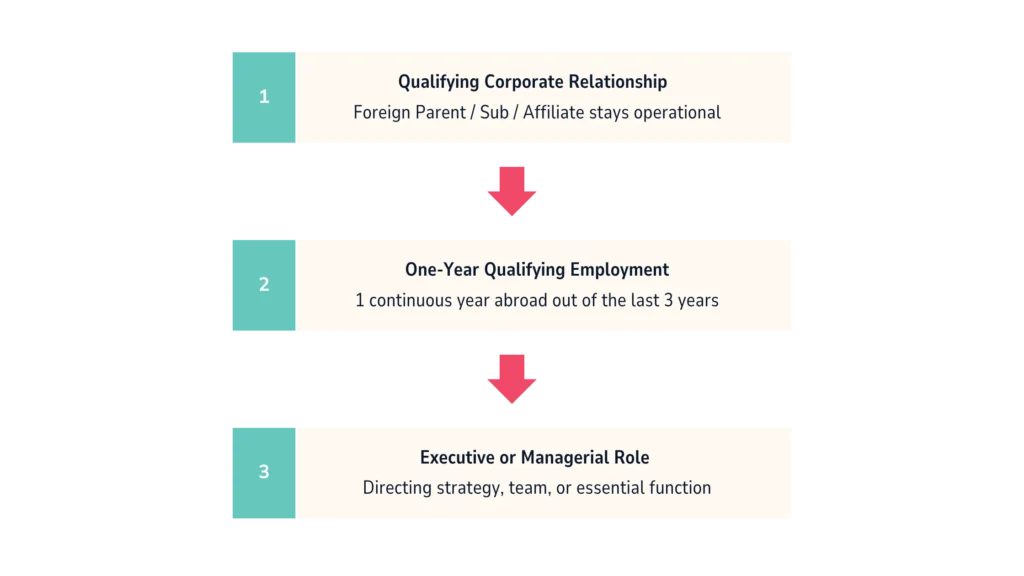
To successfully execute an L-1 visa new office filing, three fundamental elements must align seamlessly:
1. A Qualifying Corporate Relationship
Your foreign enterprise and your new U.S. entity must maintain a legally recognized corporate relationship. USCIS accepts several corporate structures:
- Parent and Subsidiary: Where the foreign entity owns a controlling share (50%+ or controlling interest) of the U.S. entity, or vice versa.
- Affiliates: Where both entities are owned and controlled by the same parent company, group, or individuals in roughly identical proportions.
- Branch: The identical corporate entity operating directly across two different national jurisdictions.
For the majority of founders, a clean parent/subsidiary setup is ideal: the foreign parent entity holds majority equity in a newly incorporated U.S. entity (typically a Delaware C-Corp or LLC). This ownership must be meticulously documented through cap tables, stock certificates, board resolutions, and formation filings.
Crucial Rule: The foreign entity must remain open, operational, and conducting active business throughout your entire stay on L-1 status. If you wind down or abandon your foreign company, you immediately lose the qualifying relationship supporting your status.
2. One Year of Qualifying Employment Abroad
You must have worked for the foreign parent or related entity full-time for at least one continuous year within the three years prior to submitting your petition. That year of employment must have been in a managerial, executive, or specialized knowledge capacity.
This requirement frequently catches early-stage founders off guard. If you incorporated your foreign startup just four months ago, you do not yet meet the mandatory history USCIS demands. Time spent building a venture informally before it was officially incorporated with operational records and payroll is difficult to count.
3. A Managerial, Executive, or Specialized-Knowledge Role
Your historical position abroad and your intended U.S. position must fit within the L-1 classification definitions.
What Qualifies as a “New Office”?
This is where many petitions encounter friction, so precision is key. USCIS expects concrete proof that the U.S. operation is real and ready to launch, despite being brand new.
In practice, satisfying the l1 visa new office standard requires three elements:
1. Secured Physical Premises
USCIS policy explicitly states that virtual offices, flexible hot-desks, or simple P.O. Box mailing addresses are generally insufficient for a new office L-1 petition. You must provide a signed commercial lease, a dedicated office room contract within a co-working space, or an equivalent physical location showing genuine capacity to conduct business. Because physical space checks are a primary trigger for RFEs, securing dedicated space early should be treated as a priority.
2. A Credible, USCIS-Aligned Business Plan
An immigration business plan is fundamentally distinct from an investor deck. It must outline what the U.S. business will do, how revenue will be generated, the exact roles to be hired over the first 12 months, and how the business will support an executive or managerial role within a year. Financial projections and headcount schedules must be realistic and backed by available capital.
3. Financial Capacity to Execute
You must prove the entity possesses or has access to sufficient financial capital to begin operations, pay your executive compensation, and fund initial hiring plans. Capital can originate from foreign parent reserves, raised seed funding, or committed investment. The core objective is proving the U.S. business will not stall due to an empty bank account.
The One-Year Initial Approval & Extension Reality
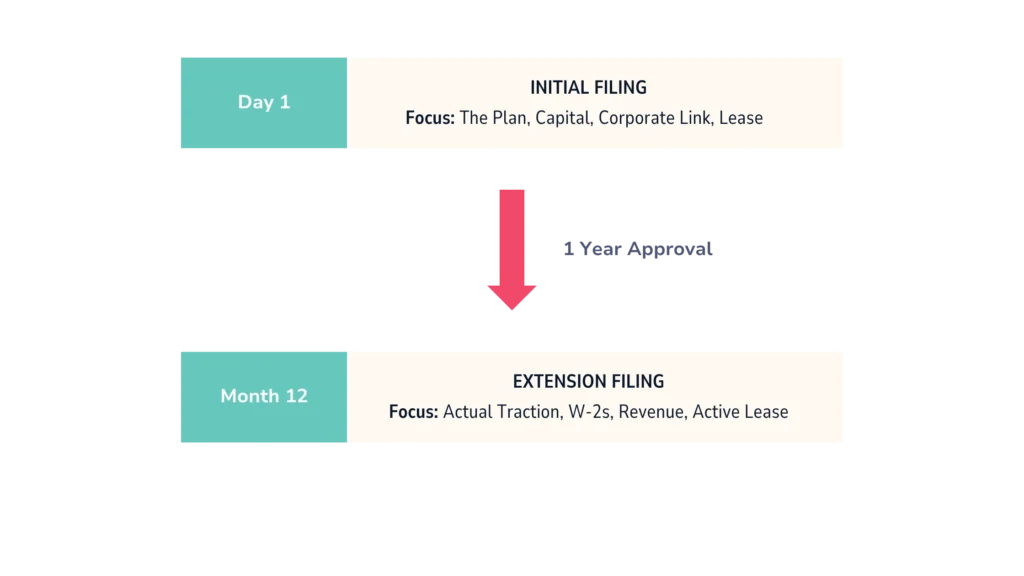
While standard L-1 transfers for established companies are approved for up to three years, a new office L-1 is granted for one year only.
Think of this first year as a performance probation. When your initial year ends, you must file an extension petition.
- Initial Filing: Evaluates your plan, funding, and corporate structure.
- Extension Filing: Evaluates your execution, hiring, payroll, and real U.S. operations.
The overall stay ceiling is up to 7 years for L-1A manager/executive holders and 5 years for L-1B specialized knowledge holders.
The Year 1 Extension Blueprint: A Quarter-by-Quarter Execution Checklist
Because your new office petition is approved on a one-year probationary basis, your clock starts ticking the moment you enter the U.S. To eliminate last-minute scrambling, treat your first year as a structured four-quarter audit trail.
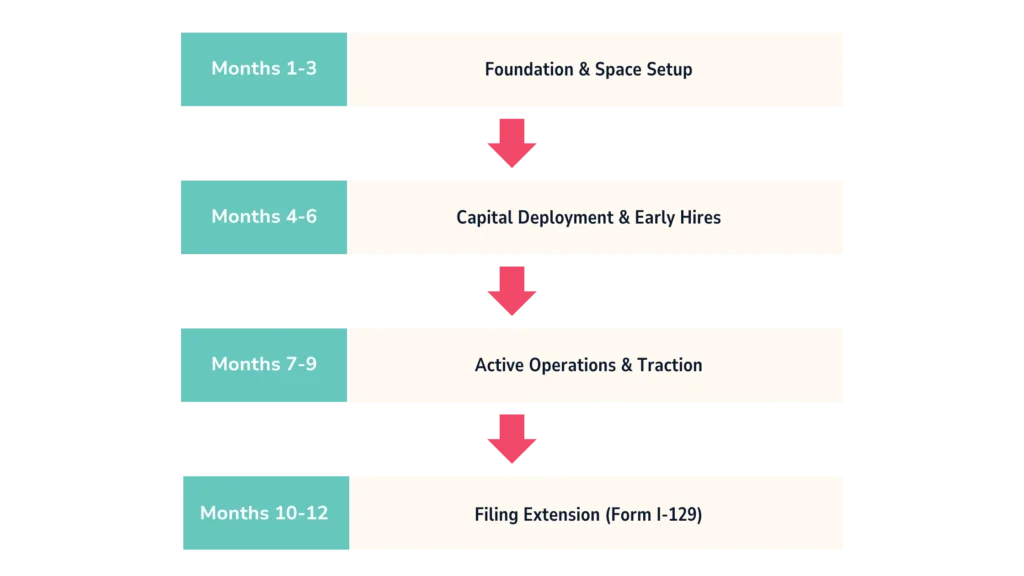
Quarter 1: Foundation & Infrastructure (Months 1–3)
- Secure Physical Workspace: Finalize and execute a signed commercial lease or a dedicated, multi-desk co-working space contract. Gather photos, floor plans, and utility documentation.
- Capital Transfer: Transfer committed launch capital from the foreign parent entity into the U.S. corporate bank account.
- Payroll Infrastructure: Set up U.S. payroll processing software and register state/federal payroll tax accounts.
- Founder Compensation: Begin drawing regular founder payroll in strict alignment with your initial L-1 petition documentation.
Quarter 2: Hiring & Operational Onboarding (Months 4–6)
- Onboard Initial Key Roles: Hire 1–2 U.S. personnel (e.g., Sales Manager, Account Manager, Lead Developer). Ensure detailed job descriptions reflect professional or supervisory duties.
- Formalize Contractor/Agency Relationships: Retain external service providers (e.g., U.S. CPA, legal counsel, marketing agencies) to demonstrate that non-managerial tasks are delegated outward.
- Quarterly Payroll Tax Filings: File IRS Form 941 (Employer’s Quarterly Federal Tax Return) to officially establish your domestic payroll footprint.
Quarter 3: Active Operations & Revenue Growth (Months 7–9)
- Client & Customer Traction: Execute customer agreements, service contracts, or sales orders showing genuine commercial activity in the U.S.
- Financial Auditing: Maintain clean monthly P&L statements, customer invoices, and bank statements showcasing steady operational expenditures and incoming revenue.
- Org Chart Escalation: Update your official company organizational chart to clearly show executive strategy (your position) sitting above operational delivery (your team/contractors).
Quarter 4: Extension Preparation & Filing (Months 10–12)
- Filing Window: Prepare to submit your L-1 extension (Form I-129) up to 180 days before your initial status expires. Do not wait until the final weeks.
- Business Plan Reconciliation: Compare actual milestones against your original business plan. Draft clear narrative explanations for any strategic operational pivots.
- Compile Evidence Package: Assemble Form W-2s, Form 941 filings, customer contracts, bank records, lease extension agreements, and updated org charts.
L-1 Visa Manager Requirements for Founders Transferring Themselves
Understanding L-1 visa manager requirements is critical for founders transferring themselves. In an early-stage startup, founders often perform direct operational work out of necessity. However, USCIS reviews petitions specifically to ensure the applicant is managing or directing the enterprise rather than simply executing tactical duties.
Managerial vs. Executive Roles Under the Law
USCIS evaluates applicants under distinct definitions:
| Capacity | Core Definition | Key Evidence Criteria |
| Personnel Manager | Directs and controls the work of other supervisory, professional, or managerial employees. | Requires direct reports who hold professional degrees or managerial titles. |
| Functional Manager | Directs an essential function, department, or strategic subdivision at a senior level. | Manages a critical asset/function (e.g., US Expansion, Architecture) without needing a large team. |
| Executive | Directs company management, sets high-level policy, and receives only general oversight. | Focuses on corporate strategy, board reporting, equity allocations, and overall corporate direction. |
For pre-seed or seed-stage founders with lean initial U.S. teams, positioning under Functional Manager or Executive capacity often provides the most accurate and viable path.
How Early-Stage Founders Qualify: Personnel Manager vs. Functional Manager:
One of the biggest misconceptions about the L-1A visa is that you need a huge headcount to qualify as a “manager.” Early-stage founders often panic looking at their small team, assuming USCIS expects a multi-tiered corporate pyramid.
For pre-seed and seed-stage startups transferring a founder, the Functional Manager route is often the secret weapon.
How to Qualify as a Functional Manager
To successfully position yourself as a functional manager in a high-growth startup, your petition must prove four core elements:
- The Function is “Essential”: You aren’t just managing generic daily tasks; you manage a critical operational driver (e.g., Global Product Architecture, US Enterprise Market Expansion, or Proprietary Tech Strategy).
- High-Level Authority: You operate with significant discretionary power over budgets, strategic direction, key partnerships, and policy decisions.
- Delegation of Tactical Work: You do not execute the hands-on, day-to-day operational work yourself. You delegate tactical execution to lower-level employees, specialized contractors, external agencies, or the home-country team.
- Senior Placement: You report directly to the Board of Directors, executive officers, or hold ultimate authority as CEO/Founder.
Key Takeaway for Founders: If you write 100% of your product’s code, handle routine customer support tickets, or personally run social media ads, USCIS will argue you are a primary worker, not a functional manager. Structure your role to direct these functions, while delegating the manual labor.
L-1 Visa Dependent Family Coverage
The treatment of family members is one of the strongest practical benefits of the L-1 framework. Your legal spouse and unmarried children under age 21 qualify for L-1 visa dependent coverage under L-2 status.
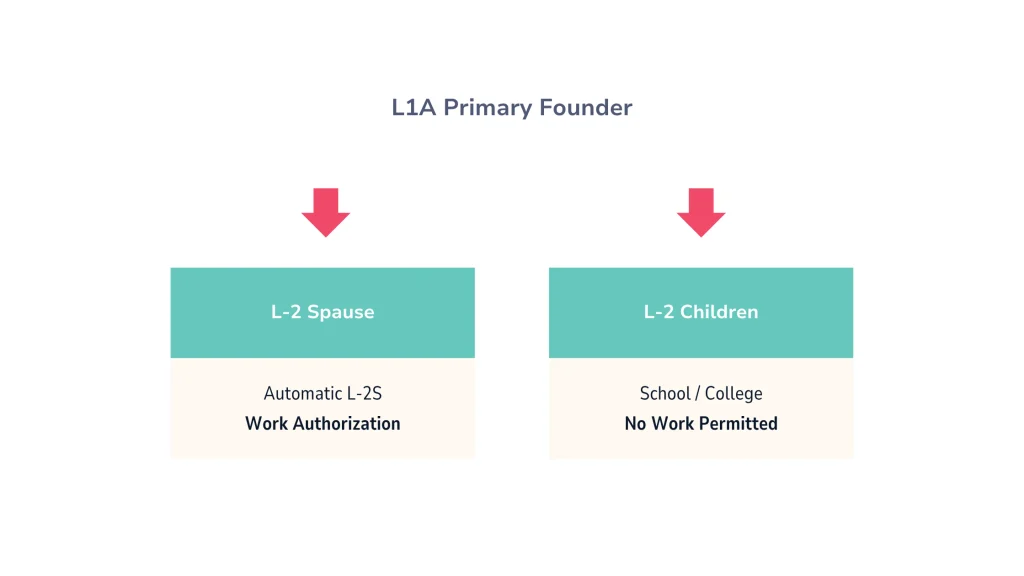
Key Rules for L-2 Dependents:
- Spousal Employment Authorization: L-2 spouses are employment authorized incident to status. Upon entering the U.S., an L-2 spouse receives an I-94 arrival record annotated with “L-2S” status. This document permits them to work for any U.S. employer or run their own business immediately, without waiting months for a physical Employment Authorization Document (EAD) card.
- Education for Children: L-2 dependent children can attend U.S. K-12 public or private schools, as well as colleges and universities, without needing a separate F-1 student visa. Note that L-2 children are not permitted to work.
- The “Aging Out” Horizon: Dependent children lose L-2 derivative status upon reaching their 21st birthday. Families with teenage children should map out green card timeline strategies early to prevent children from aging out of eligibility.
Realistic Execution Timeline
- Stage 1: Corporate Formation & Document Gathering: 4 to 8 weeks.
- Stage 2: Business Plan & Petition Compilation: 3 to 6 weeks.
- Stage 3: USCIS Adjudication: 15 business days with Premium Processing (or several months via standard processing).
- Total Estimated Runway: 3 to 8 months from entity formation to U.S. arrival.
How to Set Yourself Up for Approval
To maximize petition success, keep these fundamental principles top of mind:
- Keep Corporate Structures Clean: Ensure shareholder cap tables, parent-subsidiary relationships, and foreign operational continuous checks are cleanly documented.
- Secure Dedicated Workspace: Avoid generic virtual mailboxes or flex-desk spaces. Secure a lease for dedicated, private space.
- Build an Immigration Business Plan: Ensure organizational charts, hiring plans, and financial projections demonstrate managerial capacity within 12 months.
- Structure Your Role Deliberately: Frame your daily responsibilities around directing strategy, managing functions, or leading teams rather than executing frontline tasks.
- Prepare for the Extension from Day 1: Maintain meticulous records of payroll filings (Form 941s), employee W-2s, customer contracts, and client invoices.
Top 3 RFE Traps for Startup Founders (And How to Avoid Them)
Receiving a Request for Evidence (RFE) stalls your momentum and adds unnecessary legal expenses. For new office L-1 petitions, USCIS RFEs almost always center on three predictable pitfalls.
1. The “Operational Overload” Trap (Doing vs. Managing)
- The Trigger: USCIS reviews your organizational chart and concludes that because you only have one or two early employees, you must be doing the hands-on operational work yourself.
- The Fix: Clearly map out how non-managerial tasks are absorbed. Show how foreign parent company staff support U.S. operations, or demonstrate that specialized external agencies (marketing, accounting, legal) execute the day-to-day tactical work.
2. The Shared Desk / Virtual Address Trap
- The Trigger: Submitting a basic virtual mailbox address, a P.O. Box, or an unreserved flex-desk membership at a co-working space. USCIS strictly mandates physical space capable of housing your U.S. team.
- The Fix: Rent dedicated square footage. If using a co-working space (e.g., WeWork, Industrious), ensure your lease explicitly designates a private, dedicated office suite with assigned desk spaces. Include floor plans, photos showing company signage, and full lease agreements in your filing.
3. The “Unrealistic Growth” Business Plan Trap
- The Trigger: Submitting an overly ambitious pitch deck that projects 40 full-time U.S. hires in Year 1, despite only having $150,000 in seed funding. USCIS will flag the business plan as unviable and non-credible.
- The Fix: Ensure your immigration business plan is rooted in financial reality. Scale your projected hiring directly to your available runway, seed funding, and realistic revenue growth. A tight, well-funded 3-to-5 person organizational structure carries far more credibility than an underfunded fantasy empire.
| Common RFE Risk | What Triggers USCIS Suspicion | How to Secure the File |
| Operational Overload | Founder appears to do manual/technical labor. | Document external contractors, foreign staff support, and agency retainers. |
| Space Suitability | Mailboxes, P.O. Boxes, flexible shared tables. | Signed private office lease, lease floor plan, space photos with logo. |
| Unviable Plan | Aggressive hiring goals unbacked by capital. | Align staffing projections directly with verified bank balances and runway. |
The Bottom Line
The L-1 visa new office route provides an effective framework for international founders seeking to expand into the U.S. market. It enables you to transfer yourself to build operations, bring your family with work authorization for your spouse, and establish a direct pathway toward U.S. permanent residency.
Success depends on understanding that Year 1 is evaluated on execution. By structuring your business entity properly, maintaining dedicated space, meeting managerial standards, and treating the first 12 months as a structured audit, you set your business up for a smooth extension and long-term expansion in the U.S. market.
Not sure if you qualify for O-1A, O-1B, EB-2 NIW or EB-1A?
Fill the form and get FREE ASSESSMENT from our attorney or book 20min. introducing consultation.