

EB-2 NIW RFE: How to Respond and Win Your Case

An RFE is not a denial. It’s the officer telling you exactly where your petition fell short, and giving you one clean shot to fix it. This guide walks through what triggers an EB-2 National Interest Waiver RFE, how to read the notice, how to structure a winning response, and the most common RFE reasons with specific counter-arguments for each. It closes with real questions mid-process applicants have asked and the answers they got from U.S. immigration attorneys and paralegals, with links to the original conversations.
Not legal advice. This article is general information. Every NIW case turns on its own facts, and the National Interest Waiver is a discretionary category. Consult a licensed U.S. immigration attorney before responding to any RFE.
First, what an RFE actually is
A Request for Evidence (RFE) means the officer reviewing your Form I-140 cannot yet approve the petition on the record in front of them. Something is missing, unclear, or unpersuasive. It is a request, not a rejection, and critically, your priority date stays intact while you respond. Many petitions are approved after a well-prepared reply.
You typically get 30 to roughly 87 calendar days to respond, with the exact deadline printed on the notice. Miss it and USCIS decides on the existing record, which usually means denial. If you filed with premium processing, the clock resets when USCIS receives your response, and the agency then has 45 business days to act (approve, deny, or issue a Notice of Intent to Deny).
One structural point worth internalizing early: since the January 2025 policy update, USCIS confirms you actually qualify for the underlying EB-2 classification before it even reaches the three-part National Interest Waiver test. So a modern RFE can attack your basic EB-2 eligibility, any of the three NIW prongs, the consistency of your paperwork, or all of the above.
The legal skeleton every response must map to
Every NIW petition is measured against the three-prong test from the 2016 precedent decision Matter of Dhanasar, 26 I&N Dec. 884 (AAO 2016). You must show, by a preponderance of the evidence, that:
- Prong 1, Your proposed endeavor has both substantial merit and national importance.
- Prong 2, You are well positioned to advance that endeavor.
- Prong 3, On balance, it would benefit the United States to waive the job-offer and labor-certification requirements.
On January 15, 2025, USCIS issued its most detailed NIW guidance in nearly a decade (Policy Alert PA-2025-03), now controlling in Policy Manual Vol. 6, Part F, Ch. 5). It didn’t change the three prongs, but it spelled out how officers apply them, and it added an explicit threshold EB-2 eligibility screen. That guidance applies to every petition pending on or filed after that date, which is why RFEs since early 2025 read differently from older ones.
An RFE almost always targets one or more of these elements. Identifying which is the entire game.
What triggers a NIW RFE
RFEs are rarely random. The common triggers cluster into a handful of buckets:
- Vague or shifting “proposed endeavor.” If you describe a field or a job title rather than a specific endeavor, the officer can’t assess national importance. This is the single most common weak point.
- National importance is argued at the level of the field, not your work. “Public health matters to the U.S.” is not the same as showing your endeavor has broad implications.
- No independent proof you’re well positioned. Recommendation letters full of praise but no citations, adoption, revenue, patents, or third-party validation behind them.
- Boilerplate or overreaching letters. Since January 2025, generic letters and letters that overstate impact draw scrutiny rather than deflect it.
- Threshold EB-2 mismatch. An advanced degree (or bachelor’s plus five years of progressive post-degree experience) that doesn’t line up with the proposed occupation, e.g., a chemistry background pursuing an unrelated venture.
- Entrepreneur cases relying on generic economic benefit. Broad “I’ll create jobs and grow the economy” claims without a detailed, evidence-backed business plan.
- Credibility and consistency gaps (a 2025–2026 trend). Some officers now cross-reference the I-140 against prior filings (DS-160, ETA-9089, past petitions). Mismatched dates, titles, or employer names can trigger a credibility RFE across all three prongs.
- Address-history / biometrics requests. Since around April 2025, some I-140 applicants have received RFEs asking for residential address histories and biometric data.
- Simple documentary gaps. Missing degree copies, transcripts, credential evaluations, or an outdated résumé.
Practitioners widely report that RFEs and NOIDs became more frequent and more demanding through 2025, alongside a large jump in NIW filing volume (firms describe volume growth ranging from roughly 190% to a tripling in recent years). Treat a thin petition as a target.
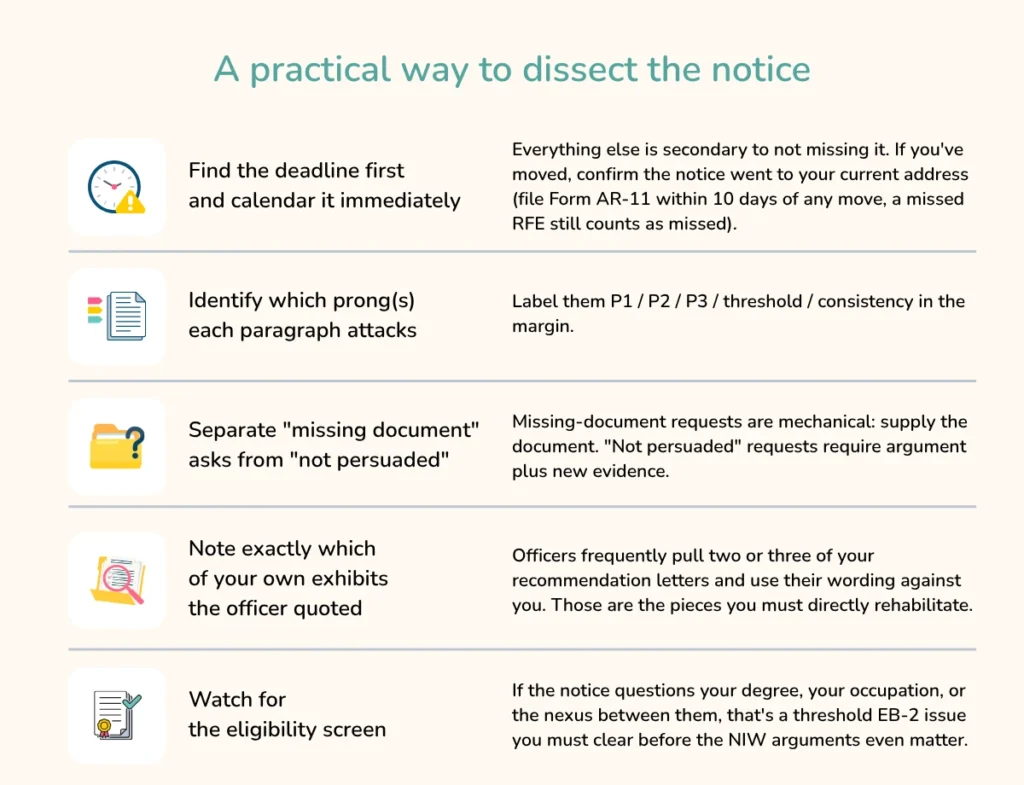
How to read the USCIS notice
RFE notices are heavily templated. The same block of language gets reused across many cases, which means two things:
- Not every sentence is a real concern. Some templated paragraphs are boilerplate the officer pastes in wholesale. Others point to the specific gap in your file. Learn to tell them apart.
- The officer is often signaling more than the template literally says. A strong response answers both the explicit request and the concern beneath it.
How to structure a winning response
The strongest RFE responses share a pattern. They don’t argue with the officer or re-send the original petition louder, they supply what was missing and make it impossible to miss.
1. Lead with a cover/response letter that maps evidence to the law. Your attorney will prepare a legal narrative that ties each new exhibit to the specific Dhanasar prong or eligibility element the RFE questioned. Officers work under time pressure; the easier you make it to understand everything on first read, the better.
2. Answer the explicit ask and the signal. Address what the officer literally requested, then address the concern the templated language implies. A response that only answers the literal words often leaves the real doubt intact.
3. Provide new documentary evidence for every stated deficiency. New recommendation letters, updated citation counts, recent press, new grants or awards, implementation/adoption evidence, a detailed business plan. Reshape the narrative around impact and clarity rather than just adding volume.
4. Prioritize independent, third-party validation. Evidence from recognized authorities with no personal tie to you (and, where relevant, government sources) generally carries more weight than additional letters from close colleagues. One authoritative independent source can outweigh ten friendly ones.
5. Build an exhibit map with numbered exhibits. Number every document and reference it by number in the letter so the adjudicator can find each item instantly. An organized, surgical package beats a thick, unstructured one.
6. Reconcile every inconsistency, proactively. If dates, titles, or employer names differ across your filings and résumé, explain and correct them in the response even if the RFE only hints at it.
7. Respond early, completely, and once. A complete package submitted well before the deadline is stronger than a scramble in the final week. Partial responses are permitted and sometimes succeed, but a full response is the goal.
The most common RFE reasons, with specific counter-arguments
| What the officer says: | Counter-argument: | |
| Threshold: “You haven’t shown you qualify for EB-2” | Questions whether your degree makes you a member of the professions with an advanced degree (or bachelor’s + 5 years progressive post-degree experience), whether your occupation is a “profession,” or whether your qualifications relate to the endeavor. | Submit a credential evaluation establishing your foreign degree is equivalent to a U.S. master’s (or bachelor’s + five years of progressive, post-degree, specialty-related experience), plus official transcripts. Show the proposed occupation qualifies as a profession under INA 101(a)(32). Most importantly, draw a clear line between your education/experience and the proposed endeavor, the January 2025 guidance explicitly rejects, for example, a chemistry degree paired with unrelated experience when the endeavor is chemistry-related. For exceptional-ability cases, show the ability shares skills, knowledge, or expertise with the endeavor. |
| Prong 1: “Your work is valuable but not of national importance” | The endeavor looks too local, too narrow, or benefits only specific clients/employers; the field may be important but your specific work isn’t shown to be. | First, define a specific proposed endeavor, not a field, not a job title. Then demonstrate its broader implications for the field, a region, or the country. Tie it to recognized U.S. priorities: critical and emerging technologies, public-health advances, national security, or substantial positive economic effects such as job creation in economically depressed areas. Provide evidence of prospective reach beyond a single organization. Avoid the traps the policy manual names as generally insufficient: classroom teaching alone, consulting for others who happen to work in an important field, and “regular” local businesses. |
| Prong 2: “You aren’t well positioned / no measurable impact yet” | Your record doesn’t yet show influence on the field; recommendation letters are generic; a business plan lacks probative detail. | Lead with independent corroborating evidence, citation counts, evidence your work was adopted or implemented by others, media coverage, patents, licenses, competitive grants, or investment. Pair specific, credible letters from people with firsthand knowledge of your work with independent letters from recognized experts who have no personal connection to you. For entrepreneurs, submit a detailed business plan with market analysis, competitive assessment, an operating model, three-to-five-year financial projections, and concrete milestones, officers want feasibility and execution readiness, not aspiration. Document progress: grants, revenue growth, hires, partnerships. |
| Prong 3: “You haven’t shown why waiving labor certification benefits the U.S.” | It’s not clear why it’s impractical or against the national interest to require a job offer and PERM labor certification. | Argue, on balance, that it would benefit the United States to waive the requirements, for instance because you are self-employed or an entrepreneur for whom a labor-certification process is impractical, because your contributions are urgent or time-sensitive, or because the national benefit of your endeavor outweighs the value of the labor-market test even if qualified U.S. workers exist. Note that being eligible for (or even already in) an employer-sponsored EB-2 does not bar you from the NIW route, the January 2025 guidance confirms this flexibility. |
| Consistency/credibility: “Your filings don’t match” | Cross-referenced documents show discrepancies in dates, titles, or employers. | Reconcile every date, title, and employer name across the I-140, résumé, and any prior DS-160, ETA-9089, or earlier petition. Provide a clear written explanation and corrected documentation. If you filed EB-1A and EB-2 NIW in parallel, make sure the core facts and scope of contributions are internally consistent even though the legal standards differ. |
| Documentary/procedural: “We need a specific document” | A discrete item is missing, degree copy, transcripts, evaluation, updated résumé, or (in adjustment-of-status contexts) a form question. | Supply exactly what’s requested. One recurring point of confusion: NIW self-petitioners generally do not need Supplement J (that form is for job-offer-based cases). If an RFE asks for it in error, respond with a courteous written explanation and confirm you selected the correct EB-2 NIW classification on the I-140. |
Common mistakes that sink RFE responses
- Re-submitting the original petition with a few extra pages instead of directly curing each stated deficiency.
- Answering only the literal request and ignoring the concern the officer signaled.
- Piling on more letters from close colleagues instead of adding independent, third-party validation.
- Describing the field’s importance rather than the specific endeavor’s.
- Leaving inconsistencies across filings unexplained.
- Waiting until the final week, then filing an incomplete package.
- Letting the notice go to an old address (always keep AR-11 current).
Bottom line
An EB-2 NIW RFE is a diagnosis, not a verdict. It tells you precisely which element, threshold eligibility, national importance, being well positioned, the balancing test, or consistency, the officer isn’t sold on. Win by reading the notice surgically, mapping new and independent evidence to the exact Dhanasar element in question, organizing it so the officer can’t miss it, and answering both the words on the page and the doubt behind them.
Not sure if you qualify for O-1A, O-1B, EB-2 NIW or EB-1A?
Fill the form and get FREE ASSESSMENT from our attorney or book 20min. introducing consultation.